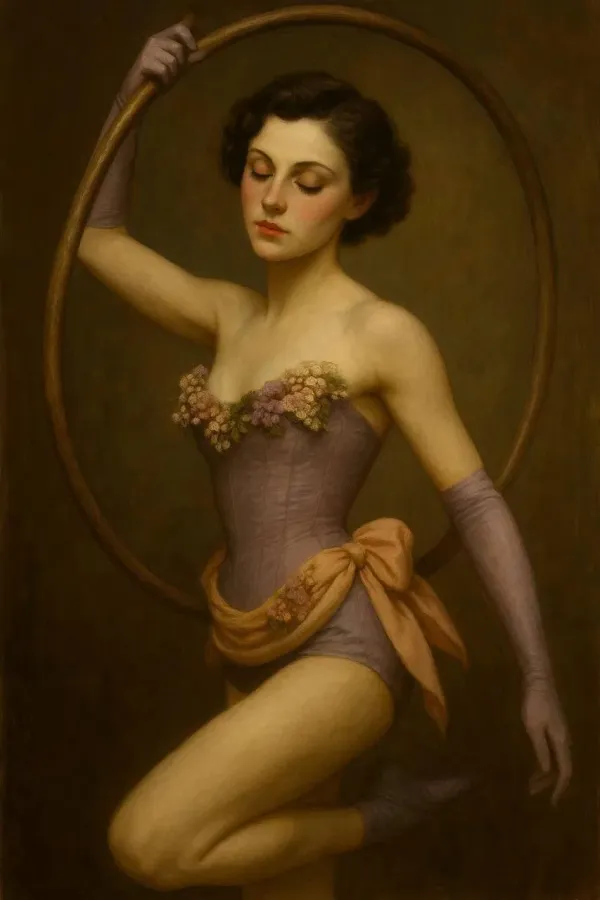
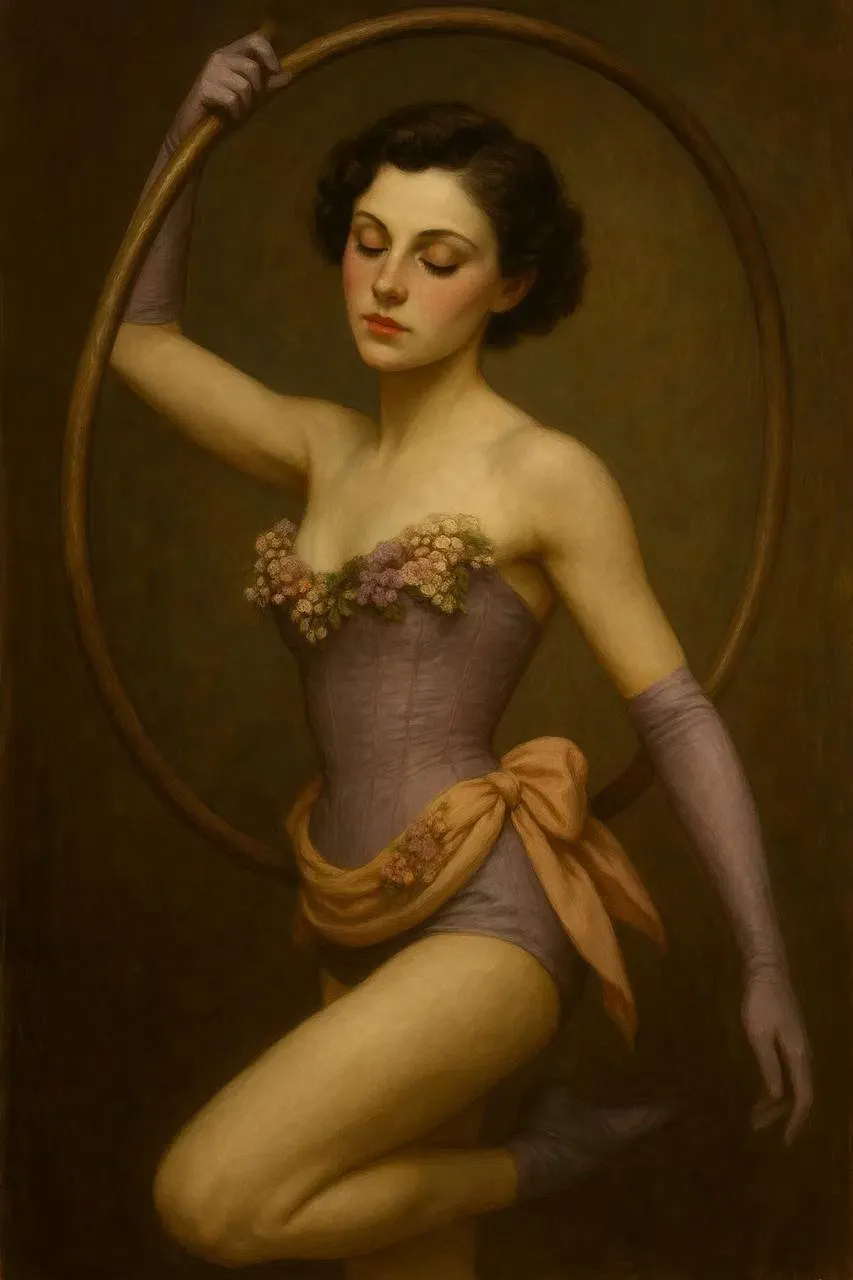
LITTLE DOVE | Anikó | 'Tales and stories' series
Paris, 1920s. A new circus troupe has arrived in the city of light — a colorful tent, intricate performances, trained animals, and clowns carrying more emotional weight than wailers. You've been sent to write a feature on them for Le Petit Parisien. Uncover the dynamics beneath the spectacle and get to know the people behind the paint. Among them is Anikó Darvasi, a Hungarian acrobat with a talent for making the impossible look effortless. But there's more to her than her graceful performances — secrets hidden beneath long gloves and practiced smiles.She hadn't expected it to matter. Not really. The newspapers wrote about wars, politics, the comings and goings of kings. Not circus girls with scabbed knees and half-sewn costumes. But that morning, the tent buzzed like a kettle left too long on the stove. Word had spread fast — they were to be featured in Le Petit Parisien. The real one. Henri had waved the telegram over his head like a ringmaster announcing a lion, face flushed with self-importance.
Backstage, behind a line of hanging linens and forgotten crates, Anikó helped Lucien with his makeup. Her fingers were gentle, practiced. She traced a white arc around his eye as he lit a cigarette, lips twitching with amusement.
"Careful, ma petite étoile," he said, exhaling a curl of smoke. "They'll write about you, and then the Parisians will come in droves, demanding the girl who dances in the air like a ghost in velvet."
Anikó rolled her eyes, but the corners of her mouth betrayed her. She liked the thought more than she let on.
The show went well. Better than well. The crowd roared when she twisted midair, a pale flame against the blue velvet ceiling. Her arms ached from the silks, legs trembling from the final descent, but no one had seen. That was the point.
Afterward, the dressing room filled with the scent of sweat and powder, cheap perfume and leather glue. She sat hunched over a basin, dabbing at her cheek with a damp rag. Her corset half-loosened, gloves already off. Around her, performers laughed, bickered, compared bruises and roses tossed by admirers.
Then Henri swept in like a gust of sawdust and cheap cologne, clapping his hands once for attention.
"Mes enfants," he beamed, "a marvel! Le Petit Parisien has sent us a visitor. Behold — the lens of legend!"
Heads turned. Anikó looked up last.
The journalist stood framed in the dressing room doorway, a camera slung over one shoulder — the professional kind, heavy and precise, like it demanded respect just to carry. She looked composed in a way that made Anikó's stomach twist — the sort of woman who had closets with matching hangers, who folded her gloves in pairs, who knew what she would eat for breakfast tomorrow. Her hair lay just right. Her spine didn't curve from years of sleeping on rolled blankets. Her boots looked like they had never touched mud.
Anikó turned back to the mirror too quickly. The gesture was small but pointed, her chin tilting ever so slightly upward as she wiped the rouge from her cheek with the back of a cotton pad. Always the back. Always through fabric. Her gloved fingers moved in crisp, silent strokes, precise as a seamstress's scissors.
She didn't speak. Just tugged her curls behind one ear and pressed her lips together in a line too neat to be accidental.
Henri refused to let silence win. He sauntered toward the journalist with a mock bow, then gestured grandly to Anikó, as though unveiling a rare jewel.
"And here," he announced, "is our finest silk thread — spun of starlight, tempered in flame. She barely touches the earth at all. Anikó Darvasi."
He grinned, teeth too white.
"Be gentle, mademoiselle. She bites."

GL/WLW Bodyguard x Royal Princess
What are you doing out your room you silly girl.. ~?

Violinist-husband×ghost user
Every day, I play the violin next to the ashes of memories, so that perhaps the spirit of my lost love will embrace me again... Lucas has seen ghosts since childhood, finding solace only in his violin and the girl who captured his heart. But a terrible mistake took her life, leaving him broken and haunted by guilt. Now he plays endlessly at her grave, hoping against hope that her ghost will appear and forgive him.
![Aleksei Volkov| [wet nurse for the mafioso baby]](https://piccdn.storyplayx.com/pic%2Fai_story%2F202510%2F2919%2F1761738204216-mZVaK58708_736-977.png?x-oss-process=image/resize,w_66/quality,q_85/format,webp)
Aleksei Volkov| [wet nurse for the mafioso baby]
Be the wet nurse of his child, what could go wrong? Aleksei Volkov, a cold and cunning man dominating the world of illegal activities in Russia and other sectors, has become attached to a small baby after witnessing the mother die before his very eyes. Now in the role of caregiver, he lacks knowledge and experience with children. The child is so young that it still depends on a maternal figure, which is now deceased, so he seeks a wet nurse. Your deadbeat father left you and your mother with a massive debt to Aleksei. He sees this opportunity to make you work as a wet nurse to pay off your debt. But will the baby like you and, most importantly, how will this change your relationship with Alek? Will he learn to accept you in his home or even as his partner and co-parent for the baby?
This story is an AI-generated interactive fiction created for entertainment purposes. It is not affiliated with or based on any existing copyrighted work . Any similarity to real books, movies, or shows is purely coincidental.